
| KEY TAKEAWAYS |
|---|
| • A Mustang II front suspension is an independent double A-arm design with rack and pinion steering. It became the default hot rod IFS because it is compact, light, and fits narrow early frames. |
| • Most kits weld in. The crossmember position, set with the chassis at ride height, decides your ride height, caster, and steering geometry, so measure twice before the first tack weld. |
| • Choose kit width by measuring frame rail spacing and your target wheel-mounting-surface width, not by vehicle make alone. |
| • Coilover conversions remove the factory-style spring towers, which frees space for V8 headers and wide engines. |
| • Hot Rod Hardware stocks Heidt's IFS kits, crossmembers, spindles, control arms, and steering components for Mustang II style conversions. |
A Mustang II front suspension conversion replaces a solid front axle or a worn-out early independent setup with a compact double A-arm system and rack and pinion steering. The design traces back to the 1974 to 1978 Ford Mustang II, but almost nothing in a modern kit comes from that car. Today's kits are aftermarket systems built around the same geometry, with stronger crossmembers, tubular arms, dropped spindles, and coilover options. This guide covers how the system works, which builds it suits, how to choose kit width and components, and what to measure before you weld.
What a Mustang II IFS Is and Why Hot Rodders Use It
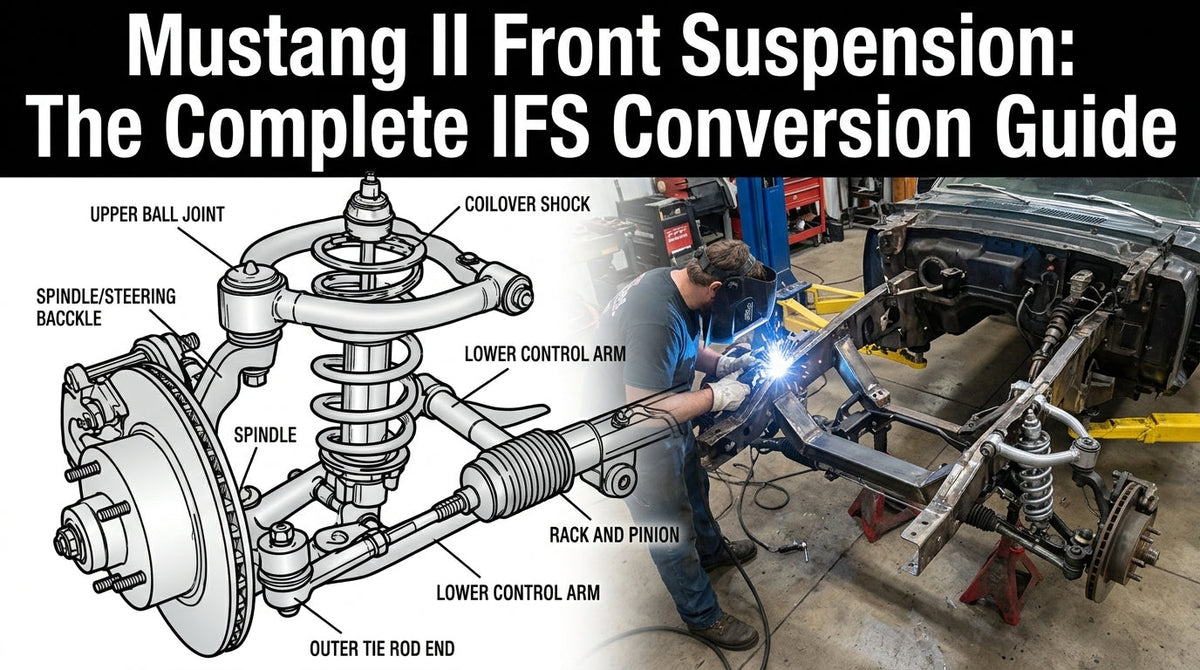
The Mustang II front end is an unequal-length double A-arm suspension. Each wheel moves independently, so a bump on one side does not rock the whole front of the car the way a beam axle does. Steering runs through a rack and pinion mounted to the crossmember, which removes the drag link, steering box, and tie rod slop that make early cars wander at highway speed.
Builders adopted it in the 1970s for three reasons that still hold. The crossmember is narrow enough to fit between early frame rails. The whole assembly is light. And the parts interchange across a huge aftermarket, so brakes, spindles, and steering racks are easy to source and replace.
The usual candidates are pre-1955 cars and trucks that left the factory with a solid front axle or a dated independent design: 1928 to 1948 Fords, 1930s and 1940s Chevys, 1948 to 1956 Ford F-1 and F-100 trucks, 1947 to 1954 Chevy trucks, and most rat rod and custom chassis. For platform-specific parts guidance on early Chevys, see Classic Chevy Parts by Generation.
What Comes in a Mustang II Front Suspension Kit
Kit contents vary by manufacturer and price tier. Confirm which of these are included before comparing prices, since a low price often means you are buying the spindles, steering, or brakes separately.
| Component | What It Does | Common Options |
|---|---|---|
| Crossmember | Mounts the arms and rack; welds to the frame | Universal weld-in or vehicle-specific |
| Upper and lower control arms | Locate the spindle and control camber and caster | Stock-style or tubular |
| Spindles | Carry the hub, brakes, and steering arm | Stock height or 2-inch drop |
| Springs or coilovers | Support vehicle weight and set ride height | Coil springs in towers, or coilover shocks |
| Rack and pinion | Steers the front wheels | Manual or power |
| Brakes | Disc rotors and calipers | Single-piston or multi-piston |
If you are building a kit piece by piece, Hot Rod Hardware carries crossmembers, spindles, and control arms separately, along with complete kits from Heidt's Hot Rod Shop.
Choosing Kit Width
Mustang II kits are sold in several track widths, and width is the decision most builders get wrong. Ordering by vehicle name alone is not enough, because frame rail spacing changes with model year, previous repairs, and boxing plates.
Measure two numbers. First, the outside width of the frame rails where the crossmember will sit. Second, your target wheel-mounting-surface (WMS) width, the distance between the hub faces on each side. That second figure, combined with your wheel backspacing, sets where the tires land inside the fenders. Match the kit to both numbers, then confirm tire clearance at full steering lock before you commit.
A kit that is too wide pushes the tires out past the fender lip. A kit that is too narrow forces a wheel with less backspacing, which changes scrub radius and steering feel. Neither is fatal, but both are cheaper to avoid with a tape measure than to fix after welding.
Coil Springs vs. Coilovers
The original Mustang II layout places the coil spring above the upper control arm, inside a spring tower. Spring tower kits cost less and ride well, but the towers take up room on both sides of the engine. That is rarely a problem with a small inline engine. It becomes one with a V8, especially when headers need to snake past the towers.
Coilover kits mount the spring around the shock, between the lower arm and the crossmember, and delete the towers. That opens up engine bay space, and adjustable coilovers let you fine-tune ride height after the car is finished. Spring rate still matters with coilovers: choose it by front-end weight, including engine, transmission, and accessories, not by guesswork. Browse shock absorbers for compatible units, and if you want adjustable ride height on the street, air ride components are another route.
Steering: Manual or Power Rack
Manual racks work well in light cars with skinny front tires and a small engine. As front weight and tire width go up, steering effort at parking speeds climbs quickly, and a power rack becomes the more comfortable choice. A power rack requires a power steering pump, bracketry for your engine, and pressure and return hoses.
Rack position matters as much as rack type. The inner tie rod pivots need to line up with the lower control arm pivots, or the wheels will toe in and out as the suspension moves. That condition is called bump steer, and it shows up as a car that darts over uneven pavement. Use the kit's rack mounting points as designed and do not shim the rack up or down to clear an oil pan without checking the geometry.
Connecting the rack to the column usually takes a pair of universal joints and a support bearing. Borgeson U-joints and shafts are the common choice, and the full steering collection covers columns, shafts, and racks.
Brakes and Bolt Pattern
Nearly every Mustang II kit runs front disc brakes. Aftermarket spindles and rotors are offered in common Ford and GM bolt patterns, so match the front pattern to your rear axle and your wheels. Mixing patterns front to rear means carrying two spares and limits wheel choices.
Caliper choice follows the same logic as any disc conversion: single-piston calipers suit most street builds, and multi-piston calipers make sense for heavier or harder-driven cars. Your master cylinder bore depends on whether you run a power booster and which calipers you choose. How to Choose a Disc Brake Conversion Kit walks through caliper, bore, and proportioning valve decisions in detail.
Before You Weld: The Measurement Checklist
Weld-in kits leave little room for correction once the crossmember is burned in. Work through this list with the chassis on stands and the body and engine weight in place or simulated.
- Set the frame at final ride height and level it side to side. Record the rake front to rear.
- Square the frame by measuring diagonally corner to corner. A twisted frame will produce a twisted front end.
- Center the crossmember on the frame centerline and confirm it sits square to that line.
- Set crossmember angle to the kit manufacturer's caster specification. Rake affects this, which is why ride height comes first.
- Check engine oil pan, headers, and starter clearance against the rack and crossmember before tacking.
- Cycle the suspension through full travel and full steering lock to check tire, frame, and brake hose clearance.
- Tack weld, re-measure everything, then finish weld in short passes to limit heat distortion.
After the car is on the ground, get a professional alignment. Treat the alignment specs in the kit instructions as the starting point, since they are based on that kit's geometry.
Where IFS Fits in the Build Order
Front suspension comes before rear suspension, brakes, and steering column work, because every one of those systems depends on final ride height and front geometry. Restomod Done Right lays out the full sequence. If you are planning a rat rod or custom chassis from scratch, the Rat Rod Parts Buying Guide covers what to source alongside the front end. Round out handling with a front sway bar sized for the kit.
FAQ
What is a Mustang II front suspension?
A Mustang II front suspension is an independent double A-arm front end with rack and pinion steering, based on the geometry of the 1974 to 1978 Ford Mustang II. Aftermarket kits use new crossmembers, arms, spindles, and steering racks built to that design, and it is the most common IFS swap for early hot rods and trucks.
Is a Mustang II kit bolt-in or weld-in?
Most universal Mustang II kits are weld-in: the crossmember welds to the frame rails. Some vehicle-specific kits are designed to bolt in. Check the listing for your exact vehicle before ordering.
How do I choose the right Mustang II kit width?
Measure the outside width of your frame rails where the crossmember will mount, then decide your target wheel-mounting-surface width based on fender clearance and wheel backspacing. Choose the kit that matches both measurements.
Do I need coilovers on a Mustang II front suspension?
No. Coil spring kits with spring towers work well and cost less. Coilovers are worth the extra cost when you need engine bay space for a V8 and headers, or when you want adjustable ride height.
Can a Mustang II front suspension handle a big block?
It can, with components rated for the weight: heavier springs or coilovers, stronger arms, and brakes sized for the load. Many builders with heavy engines step up to a kit designed for higher front weight. Confirm the kit's rated capacity against your total front-end weight.
Does Hot Rod Hardware carry Mustang II front suspension kits?
Yes. Hot Rod Hardware stocks Heidt's IFS kits plus crossmembers, spindles, control arms, and steering components for Mustang II style conversions. Call 507-527-1020 for fitment help or browse the front suspension catalog online.
|
Shop Front Suspension Kits at Hot Rod Hardware hotrodhardware.com/collections/front-suspension-kits |