
|
KEY TAKEAWAYS |
|
• A restomod suspension and brake build has a correct sequence: front suspension first, then rear, then brakes, then steering. |
|
• Heidt's Mustang II IFS kits are the most widely compatible front suspension upgrade for 1928-1972 domestics. |
|
• Upgrading front brakes without upgrading the proportioning valve causes rear brake lockup — plan the brake system as a whole. |
|
• Hot Rod Hardware stocks Heidt's, Pete and Jake's, Viking Performance, and Master Power Brakes. |
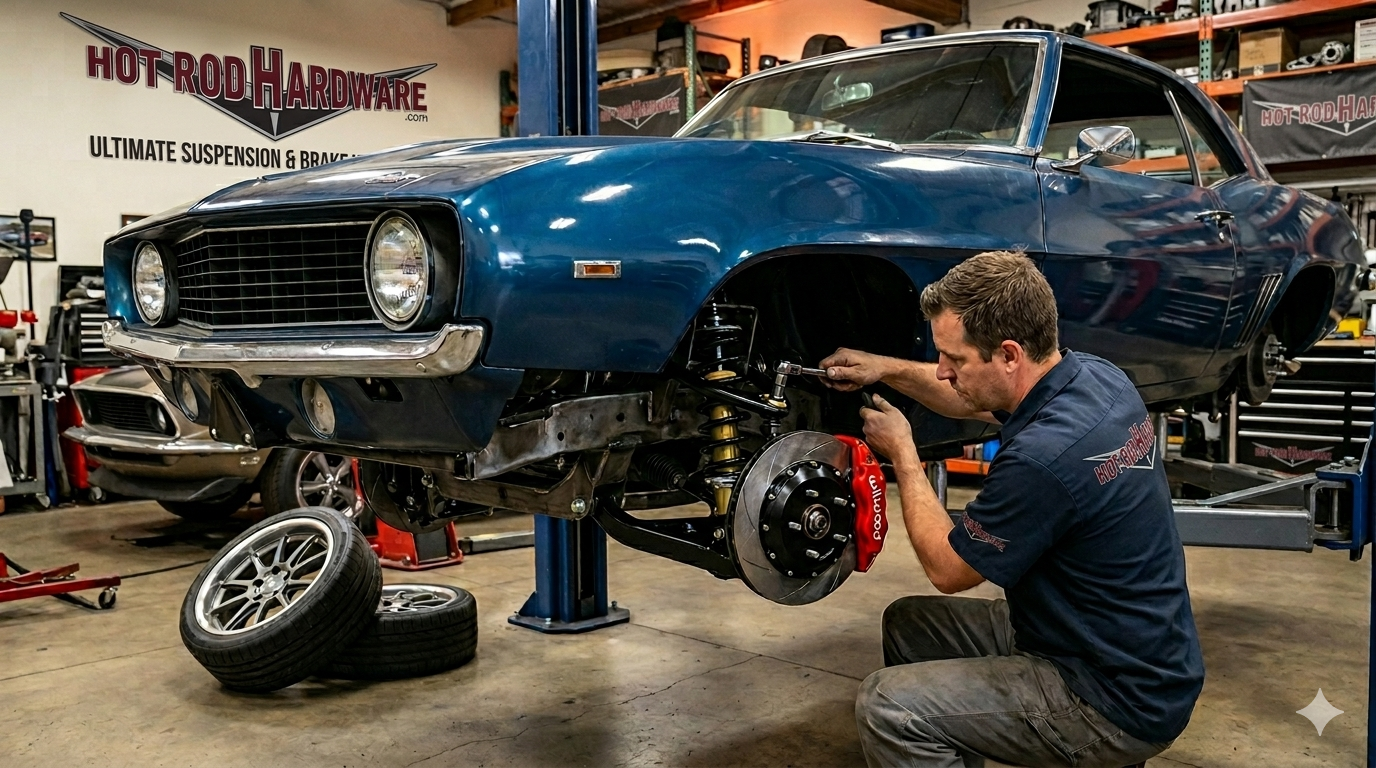
A restomod is not a restoration. The goal is not to return a car to factory condition. The goal is to take a classic body and make it drive like a modern car: flat cornering, confident braking, linear steering, and no drama. That requires replacing most of what the factory put under it. This guide covers the correct sequence for a restomod suspension and brake build, which brands fit which platforms, and what choices you need to make before spending money.
Why Sequence Matters in a Restomod Build
Suspension and brake upgrades interact. Front suspension geometry determines the steering pickup points. Steering geometry affects brake bias under hard stops. Brake system pressure affects how the car behaves at the threshold of lockup. If you install brakes before you have confirmed suspension geometry, you may need to redo the proportioning setup after the suspension is corrected.
The correct sequence for a restomod build is: front suspension first, rear suspension second, brakes third, steering fourth. This order minimizes rework and lets each system be set up against a finished base.
Step 1: Front Suspension
The factory front suspension on 1930s-1960s American cars uses kingpin or ball-joint spindles, solid front axles on early cars, and either a straight front axle or a coil-spring A-arm geometry on later cars. None of these systems produces modern handling. The front suspension upgrade is the most important single modification in a restomod build.
Heidt's Mustang II IFS Kits
Heidt's Hot Rod Shop manufactures Mustang II independent front suspension kits for a wide range of classic car applications. The Mustang II geometry uses rack and pinion steering, coil-over shocks, and a tubular subframe that replaces the factory front clip. The result is a system that handles within a few degrees of modern car performance, uses readily available parts, and fits a wide range of custom rod builds.
Heidt's front kits cover 1928-1954 Fords, 1949-54 Chevys, 1955-57 Chevys, and many A-body and B-body GM applications. The catalog distinguishes between bolt-in applications (where the subframe drops into the existing frame rails) and weld-in applications (where the subframe requires frame notching). Know which your chassis requires before ordering.
Pete and Jake's Traditional Hot Rod Parts
Pete and Jake's carries front suspension components for traditional hot rod builds that maintain the classic look while improving performance. Their dropped axle assemblies, transverse spring kits, and alignment components cover 1928-1948 Fords and similar early iron. For builders who want improved geometry without the visual change that an IFS subframe brings, Pete and Jake's provides components that work within the original front end architecture.
Step 2: Rear Suspension
Rear suspension on most 1930s-1960s American cars is a live rear axle on leaf springs. Leaf springs work, but they allow axle windup under hard acceleration and wheel steer under cornering loads. Most restomod builds replace the factory leaf spring setup with a four-link or torque arm rear suspension.
Heidt's Rear Suspension Kits
Heidt's offers rear suspension kits for early Ford and GM applications that replace the factory leaf spring setup with a parallel four-bar arrangement using coil-over shocks. The parallel four-bar maintains axle position under acceleration and eliminates leaf spring wind-up. Most Heidt's rear kits retain the factory rear axle housing while replacing the spring and locating components.
Viking Performance Shocks
Viking Performance manufactures double-adjustable coil-over shocks for hot rod and custom car applications. Their shocks are built and valved in the US and are available with spring rates and valving tailored to street, autocross, or touring applications. Viking shocks are compatible with most Heidt's and Pete and Jake's front and rear kits and are a higher-performance option than the entry-level shocks included with some suspension kits.
|
Brand |
Platform Coverage |
Front System |
Rear System |
Best For |
|---|---|---|---|---|
|
Heidt's Hot Rod Shop |
1928-1972 Ford and GM |
Mustang II IFS, dropped axle |
Four-bar coil-over |
Street rods, customs, traditional hot rods |
|
Pete and Jake's |
1928-1948 Ford |
Traditional spindle and spring |
Traditional leaf spring |
Period-correct traditional hot rods |
Step 3: Brakes
Classic car drum brakes fade under repeated hard stops. The fade is not a gradual degradation — it is a sudden loss of pedal that happens when the drums overheat. Converting to disc brakes eliminates fade and reduces stopping distances by 20-30% on most classic car platforms. Plan the brake upgrade as a system, not as individual component swaps.
Front Disc Conversion
Most restomod builds use a front disc conversion as the baseline. Four-piston calipers on 12-inch rotors provide adequate stopping power for street-driven builds up to approximately 500 HP. For high-horsepower or heavy builds, six-piston calipers on larger rotors are available.
Front disc conversions require matching the hub and rotor assembly to the front suspension uprights. If you installed a Heidt's IFS front end, use a rotor and caliper kit designed for the Mustang II spindle. Do not mix caliper mounting brackets from different systems without verifying caliper-to-rotor clearance.
Rear Drum vs. Rear Disc
Rear disc conversions are optional on most restomod builds. The rear brakes do approximately 30% of the total braking work. Converting rear drums to disc improves brake feel and heat capacity but is not required for street builds. The decision depends on build priority: if the car will see track days or mountain driving, rear discs are worth the cost. For a street cruiser, retain rear drums and upgrade the shoes to a high-friction compound.
Master Power Brakes
Master Power Brakes manufactures complete brake upgrade kits for classic car applications including front disc conversion kits, master cylinder and booster assemblies, and proportioning valve hardware. Their kits are designed as complete systems — master cylinder, booster, calipers, rotors, and brackets are matched before shipping so the builder does not need to verify component compatibility.
The proportioning valve is the most important element in a mixed front-disc, rear-drum brake system. Without a correctly calibrated proportioning valve, rear brakes apply too much force relative to front brakes under hard stops, causing rear wheel lockup before the front brakes are saturated. Master Power Brakes kits include proportioning valves matched to the front-rear brake ratio of each application.
Step 4: Steering
Steering is the last of the four systems to address because it connects directly to the front suspension geometry. Once the front suspension is set and aligned, steering ratio and effort can be optimized without redoing prior work.
Most Heidt's IFS kits include rack and pinion steering as part of the kit. The rack eliminates the steering box, sector shaft, and linkage complexity of factory recirculating ball systems and produces a more direct, consistent steering feel.
For builds that retain factory-style steering geometry (recirculating ball box), Borgeson Universal manufactures steering shafts and adapters that connect a factory column to a modern power steering rack or box. Borgeson products cover a wide range of classic car applications and are stocked at Hot Rod Hardware.
What to Plan Before You Buy
Three decisions determine everything else in a restomod suspension and brake build.
-
Street vs. occasional track: a street car needs a smooth ride and predictable handling in normal conditions. A track-capable build needs stiffer springs, adjustable shocks, and wider tires. These require different spring rates, shock valving, and brake pad compounds.
-
Power level: a 300 HP street car has different brake and suspension load requirements than a 700 HP drag-strip machine. Size every system for the peak output of your final build, not your current engine.
-
Budget sequence: front suspension first is the highest-impact investment. If budget constrains the build to one phase at a time, complete the front suspension, get it aligned, and drive the car before spending on rear suspension or brakes.
FAQ
Can I install a Heidt's front IFS kit without professional welding equipment?
Bolt-in Heidt's kits do not require welding. They use the factory frame rails as mounting points and attach with hardware. Weld-in kits require professional MIG welding and frame notching. Confirm which type fits your chassis before ordering.
What is the advantage of a power brake booster over a manual disc setup?
A power booster reduces pedal effort by 40-60%. On a street car with disc brakes front and rear, a power booster is worth the added plumbing. On a purpose-built track car where feel and firmness are priorities, a manual master cylinder with a quality high-ratio pedal assembly is preferred.
How do I know if my proportioning valve is calibrated correctly?
Drive the car to near-lockup on a safe, empty road surface. The front tires should reach the threshold of lockup before the rears. If the rears lock first, increase front bias at the proportioning valve. If the fronts lock well before the rears, decrease front bias. A correctly set car will lock all four tires at approximately the same pedal pressure.
Does Hot Rod Hardware ship suspension kits?
Yes. Hot Rod Hardware ships Heidt's, Pete and Jake's, Viking Performance, and Master Power Brakes to the continental US. Large kits ship as freight. Contact HRH at 507-527-1020 to confirm fitment for your specific application and year.