
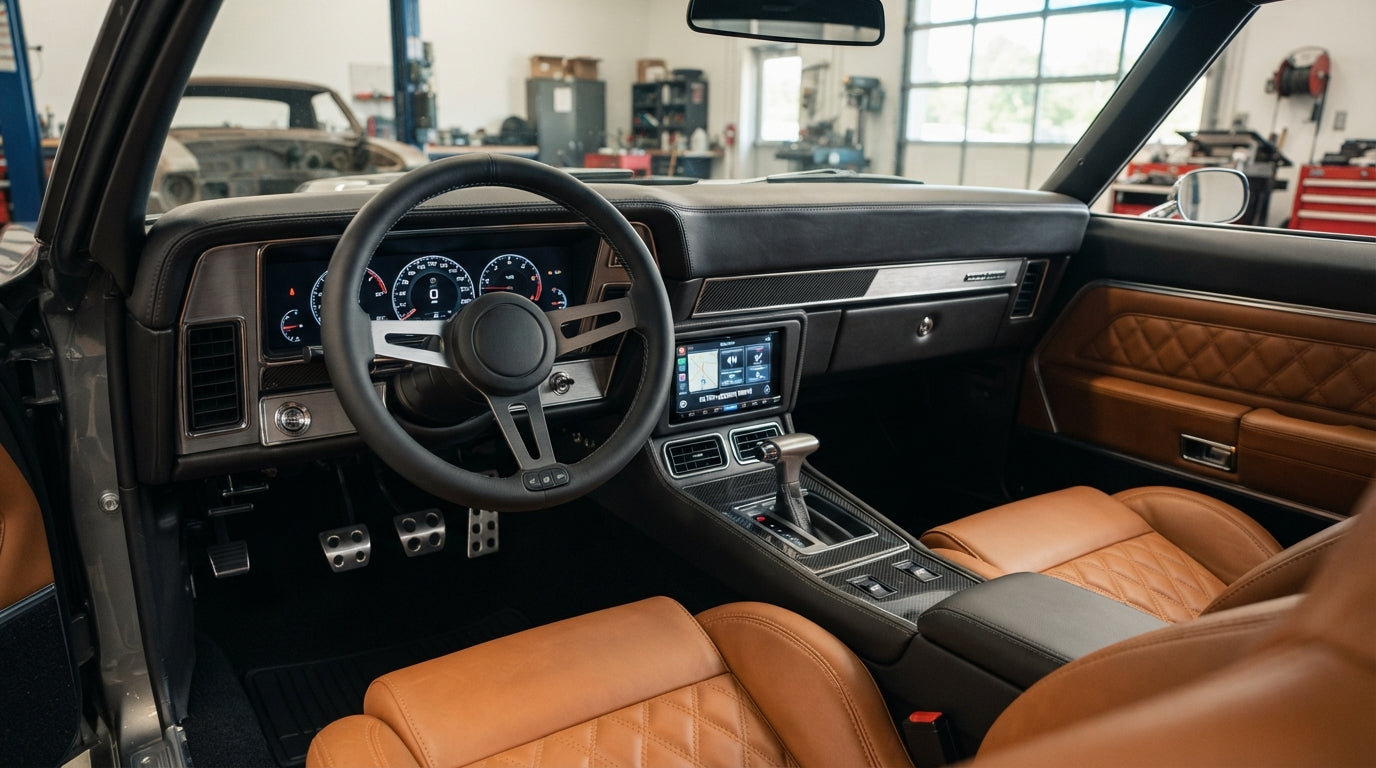
KEY TAKEAWAYS |
• The wiring harness is the first interior upgrade. Every other electrical component depends on a clean, fused power distribution backbone. |
• Classic Instruments and Dakota Digital both produce excellent gauges but serve different builder philosophies: analog-look electronic vs. fully digital display. |
• American Autowire circuit-breaker harnesses eliminate the fire risk of factory fuse links and accommodate modern accessories without splicing. |
• Specialty Power Windows kits are direct-fit power window conversions for most classic car, muscle car, and street rod applications, with no cutting required. |
• Hot Rod Hardware stocks Classic Instruments, Dakota Digital, American Autowire, Lokar, Specialty Power Windows, and Watson's Street Works for classic car interior builds. |
A factory interior from 1955 was designed for a 6-volt electrical system, two accessories, and an ammeter that told you almost nothing useful. Running that wiring in a car with a modern alternator, electric fans, and a fuel-injected engine is asking for a dashboard fire. A modernized interior is not just about looks. It is about building an electrical system that can handle the load you put on it. This guide covers the sequence for a classic car interior modernization, brand comparisons for gauges, and how to choose a wiring harness that will hold up at 70 mph.
Start with the Wiring Harness: Why It Goes First
Every other electrical component in a modernized interior connects to the wiring harness. The gauge cluster, power windows, LED lighting, ignition switch, and accessories all pull current from the same distribution backbone. If that backbone is the factory harness, with its rubber insulation crumbling and its fuse links already at capacity, adding modern accessories means adding fire risk.
A modern replacement harness solves this by redesigning the circuit layout from scratch. Instead of fuse links that blow without warning and can arc before opening, modern harnesses use blade fuses or circuit breakers. Every circuit is sized for its load, labeled, and routed with heat-resistant insulation. The result is a harness that can handle a modern alternator's output and accommodate accessories the original designers never imagined.
American Autowire
American Autowire manufactures complete wiring harnesses for classic cars and trucks. Their Classic Update and Highway Series harnesses cover most 1928-1966 applications. The Highway 22, their flagship street rod harness, includes 22 circuits with circuit-breaker protection, color-coded wiring, and printed circuit diagrams. It replaces the original harness, not supplements it.
American Autowire harnesses come pre-terminated with GM-style connectors that work with most aftermarket switches, ignition modules, and accessories. Installation requires no splicing into the original harness: cut the old one out and install the new one. Hot Rod Hardware stocks American Autowire harnesses for a range of classic car and truck applications.
Wiring Harness Selection Checklist
- Circuit count: count your planned accessories before ordering. A/C, electric fans, fuel injection, power windows, and audio systems each require dedicated circuits. The Highway 22 covers most street rod builds; high-accessory cars may need additional circuits.
- Fuse or circuit breaker: circuit breakers reset without requiring you to find a spare fuse on the side of the road. Choose a harness with circuit breakers if the car will see regular driving.
- Connector compatibility: confirm the harness connectors match your ignition switch, headlight switch, and wiper switch. American Autowire uses GM-standard connectors that fit most aftermarket switches.
- Alternator output: a high-output alternator (100+ amp) requires a heavier gauge main power wire. Confirm the harness main feed wire is sized for your alternator.
Gauge Selection: Classic Instruments vs. Dakota Digital
The gauge cluster is the most visible element of a modernized interior. Two brands dominate the classic car gauge market for different reasons, and choosing between them comes down to what you want the interior to look like and how much information you want on the dashboard.
Classic Instruments
Classic Instruments produces analog-look electronic gauges in period-correct styles. Their gauges use modern electronic internals, stepper motors and solid-state sensors, inside bezels and faces that match the visual language of 1950s-1960s American instruments. A Tri-Five Chevy or an early Ford with Classic Instruments gauges looks factory-correct at a glance while reading right.
Classic Instruments gauge sets cover speedometer, tachometer, fuel, oil pressure, water temperature, and voltage. Their speedometers are GPS-optional, eliminating the cable drive. Mounting dimensions fit factory gauge openings on most popular platforms. Confirm fitment for your specific dash before ordering.
Dakota Digital
Dakota Digital produces digital gauge displays with modern LCD or LED readouts. Their HDX and RTX series use digital displays housed in vintage-look bezels. The advantage over Classic Instruments is information density: a single Dakota Digital display can show oil pressure, coolant temp, fuel level, battery voltage, and vehicle speed at the same time, with programmable warnings and backlighting.
Dakota Digital systems also offer CAN-bus integration for late-model LS or EFI swaps, allowing the gauge cluster to read directly from the engine ECU without additional sending units. For restomod builds with modern drivetrains, this integration cuts out most of the sensor and wiring install.
Feature |
Classic Instruments |
Dakota Digital |
|---|---|---|
Display type |
Analog needle, electronic internals |
Digital LCD/LED display |
Visual style |
Period-correct, factory-look |
Modern digital, vintage-style bezels |
Information density |
One reading per gauge |
Multiple readings per display |
EFI/LS integration |
Sending unit based |
Direct CAN-bus integration available |
GPS speedometer |
Available as option |
Standard on most systems |
Best for |
Traditional and period-correct builds |
Restomod and EFI swap builds |
Power Windows: Specialty Power Windows
Power windows are the interior upgrade that gets used every single time you get in or out of the car. On a street-driven classic, they transform the ownership experience more than any gauge cluster. Specialty Power Windows manufactures direct-fit power window conversion kits for a wide range of classic car, muscle car, and street rod applications, including make-and-model specific kits and universal street rod kits for custom builds.
Specialty Power Windows kits include a gear-driven regulator, GM-style chrome switches, a complete wiring harness, and flexible stainless steel wire conduit for the door opening. Model-specific kits install using the original door panel mounting holes, with no cutting or fabricating required. Installation takes three to four hours per door for a builder with basic wiring experience.
For four-door cars and station wagons, Specialty Power Windows offers complete kits that cover every window in the car, including Tri-Five Chevy sedan and wagon configurations. All Specialty Power Windows kits are made in the USA and carry a limited lifetime warranty.
Lokar Shifters and Pedal Pads: Completing the Cockpit
The steering column, floor shifter, and pedal cluster are the touchpoints the driver's hands and feet use every mile. Lokar manufactures floor shifters, column shifter kits, throttle cables, and billet pedal pads that modernize these components without changing the visual character of the interior.
Lokar floor shifters cover most common automatic transmission applications (TH350, TH400, 700R4, 4L60E, and AOD) with column-shift and console-mount options. Their shifter handles are available in multiple styles to match period-correct or custom-look interiors. The billet aluminum construction is far more rigid than factory floor shifter assemblies.
Lokar pedal pads cover throttle, brake, and clutch pedal faces in billet aluminum or rubber-inset designs. They mount to the factory pedal arm with hardware and require no welding. On a car with a bare firewall or custom pedal assembly, Lokar also offers complete hanging pedal assemblies for disc and drum brake applications.
Watson's Street Works: Switches, Push-Button Start, and Trim
The switches, ignition, and small trim pieces a driver touches every mile do as much for interior character as the gauge cluster. Watson's Street Works manufactures custom switches, push-button start systems, power window and door lock switch kits, and interior trim accessories built for hot rod and street rod dashboards.
Watson's Street Works push-button start systems use RFID technology so the car starts only when the fob is in range, with no key cylinder required. Their billet power window and door lock switch kits replace factory crank handles with oval or dimpled rocker switches and include the wiring harness and connectors needed for a clean install. Confirm switch panel configuration (driver-side three-switch, passenger-side two-switch, or single units) against your door design before ordering, since panel layouts vary by kit.
For finishing touches, Watson's Street Works also offers billet cup holders, column and pedal trim, and waterproof LED strip lighting for underdash, dome, and accent applications, so a single brand can cover switches, start systems, and interior lighting in one order. Use a warm white (3000K) LED temperature to avoid the blue-white cast that looks out of place in a period interior.
The Interior Modernization Sequence
Like a restomod suspension build, the interior modernization has a correct order. Work out of sequence and you will be pulling panels twice.
- Strip the interior down to bare metal. Remove seats, carpet, headliner, and door panels before touching any wiring. You cannot route a new harness through a finished interior.
- Install the new wiring harness. Route all circuits before reinstalling any panels. Label every circuit at both ends before the harness is covered.
- Install the gauge cluster and dash components. Connect gauge sending units before the dashboard is buttoned up.
- Install power windows, door lock hardware, and Watson's Street Works switches. Run all door and dash wiring, including LED lighting circuits, through grommets before installing door panels and finishing the headliner and underdash area.
- Install shifter, pedal pads, and steering column. These go last. They are finish work, not structural.
Interior work rarely happens in isolation. Builders tackling gauges and wiring are often addressing suspension geometry and brake upgrades in the same build phase, and the sequencing advice in the muscle car bolt-on blueprint applies just as well to interior work. Camaro and Firebird owners planning a full interior modernization should also read Camaro Mods Done Right or Firebird Mods Done Right for the full build order specific to those platforms.
FAQ
Can I use a classic car wiring harness with a modern EFI engine?
Yes, with planning. American Autowire harnesses include enough circuits for most EFI builds. The EFI ECU, fuel pump, and injector circuits should be on dedicated fused feeds. Confirm your harness has adequate circuit count and main feed wire gauge for the total amperage draw of your EFI system before ordering.
What is the difference between Classic Instruments and Dakota Digital?
Classic Instruments uses analog needles with electronic internals for a period-correct look. Dakota Digital uses digital displays in vintage-style bezels for higher information density and direct ECU integration. Choose Classic Instruments for traditional and restoration-style builds. Choose Dakota Digital for restomods with modern drivetrains.
Do Specialty Power Windows kits work on four-door cars?
Yes. Specialty Power Windows offers complete kits for four-door sedans and station wagons, including Tri-Five Chevy applications. Each kit is sized for the specific body style and includes the switches and wiring needed for every window in the car.
What LED color temperature works best for classic car interiors?
Warm white at 2700-3000K is the most period-appropriate choice for classic car interiors. It matches the incandescent color temperature original equipment produced and avoids the clinical blue-white cast of cool white LEDs, which looks out of place in a 1950s-1960s interior.
Does Hot Rod Hardware carry American Autowire harnesses?
Yes. Hot Rod Hardware stocks American Autowire wiring harnesses for classic car and street rod applications. Contact HRH at 507-527-1020 to confirm availability for your specific application and year.
|
Shop Classic Car Interior Upgrades at Hot Rod Hardware hotrodhardware.com/collections/interior-accessories |