
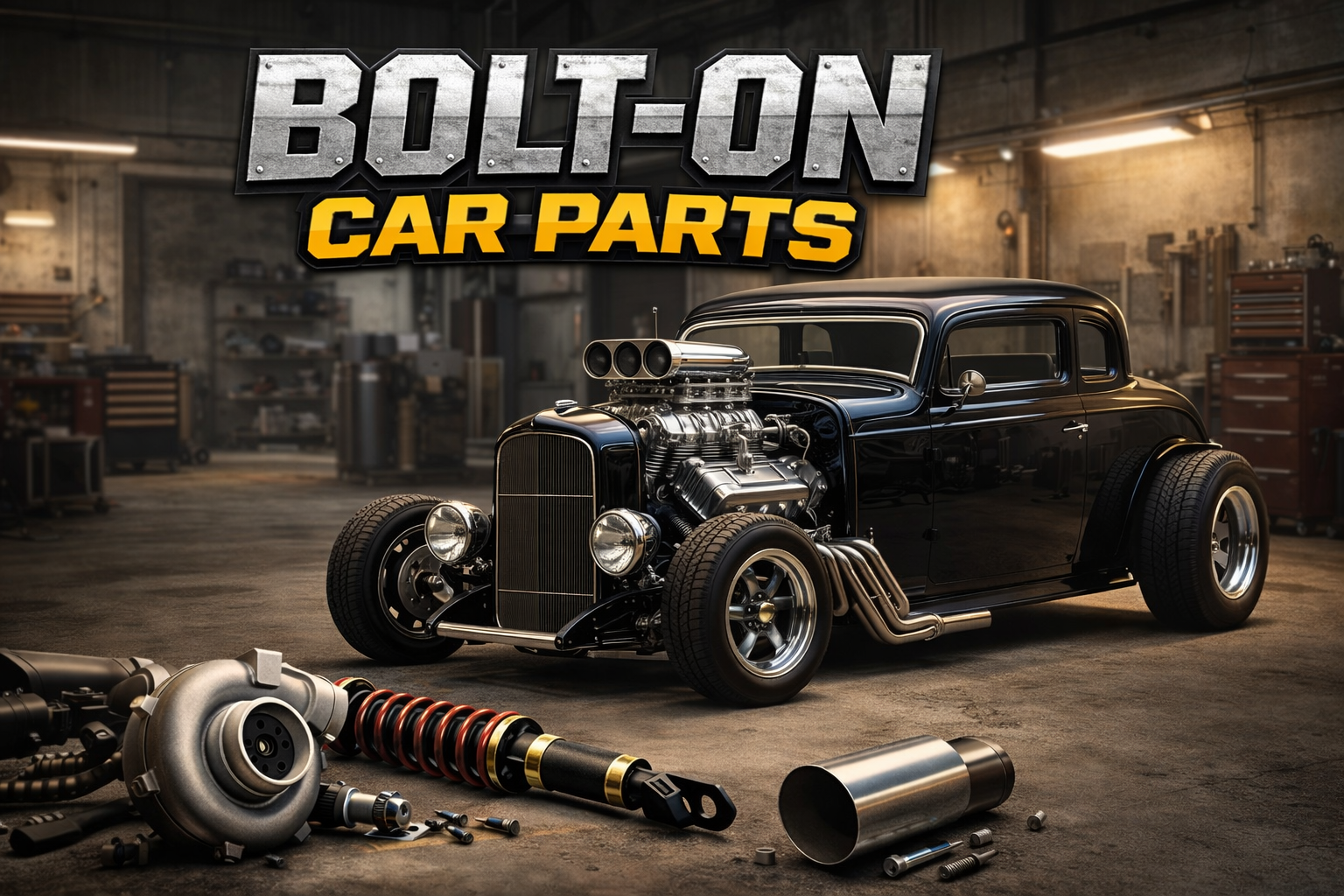
You don't need a full frame-off restoration to unlock the real potential hiding in your muscle car. A carefully chosen collection of bolt-on parts like the right coilovers, a rack-and-pinion conversion, a serpentine system, and a big brake kit can completely redefine how a classic Camaro, Chevelle, Mustang, Firebird, or Mopar performs on the street and at the track. This guide breaks down the highest-impact bolt-on upgrade categories, what to look for in each, and the recommended order to tackle them so every dollar you spend builds on the last.
What Are Bolt-On Car Parts?
Bolt-on parts are aftermarket components designed to replace or supplement factory parts without requiring cutting, welding, or major fabrication work. The name comes from the fact that these upgrades literally bolt into place using existing mounting points, making them accessible to home builders with basic hand tools and a weekend to spare.
The term covers a wide range of modifications. On the mild end, bolt-ons include things like a new intake manifold, a performance carburetor, or a set of aftermarket valve covers. On the more involved end, you have full coilover suspension conversions, rack-and-pinion steering swaps, and four-wheel disc brake kits that still qualify as bolt-ons because they use factory mounting locations and require no permanent modification to the chassis.
What makes bolt-ons so appealing for muscle car owners is the combination of accessibility and reversibility. You don't need specialized fabrication skills or equipment, the parts typically come with detailed installation instructions, and if you change your mind the car can usually be returned to stock. That said, bolt-on does not mean low-impact. Many of the upgrades covered in this guide deliver improvements that rival what you'd get from far more involved custom work, precisely because they've been engineered specifically for your application rather than fabricated from scratch.
It's also worth distinguishing bolt-on upgrades from bolt-on performance add-ons like superchargers or nitrous systems. Both use the same installation philosophy, but this guide focuses on the foundational upgrades that make a muscle car safer, more drivable, and better sorted as a complete package before you start chasing peak horsepower numbers.
1. Suspension Upgrades
The factory suspension on most muscle cars was engineered for straight-line speed and a compliant boulevard ride, not for carving corners or managing the power of a built engine. Upgrading to modern geometry components is, without question, the single highest-impact bolt-on improvement you can make to a classic American muscle car.
Coilover conversions replace the stock shock-and-spring combination with a unified, adjustable unit that lets you dial in ride height, spring rate, and damping independently. Brands like RideTech, Viking Performance, and Heidts offer vehicle-specific coilover kits for nearly every popular muscle car platform. For second-gen F-bodies, the Heidts Pro-G full front subframe for the 1970–81 Firebird is a standout bolt-in that accommodates massive 335mm front tires and virtually any Chevrolet powerplant from small block to LT. Browse the full range of Suspension Kits and Components to find application-specific fitments.
Tubular control arms address the flex and binding that plague rubber-bushed factory arms under hard cornering. Tubular steel arms with polyurethane or heim-joint ends are a direct bolt-in on most A-body and F-body platforms and deliver a measurable improvement in steering response and cornering predictability. Check the Control Arms collection for fitments from Detroit Speed, Heidts, and Chassis Engineering.
Sway bar upgrades are among the most cost-effective handling improvements available. A thicker, stiffer front bar dramatically reduces body roll in corners and pairs perfectly with any coilover conversion. Most kits require zero drilling or cutting and can be completed in an afternoon.
Pro Tip: When upgrading front suspension, always address the rear at the same time. A stiff front end paired with soft factory rear leaf springs creates understeer and makes the car difficult to drive at the limit. A matched coilover or four-link rear conversion completes the package and gives you a balanced, predictable chassis.
2. Power Steering
Many muscle cars left the factory with manual steering boxes that feel heavy at low speeds and vague at highway pace. Upgrading to a modern rack-and-pinion power steering system is one of the most transformative bolt-ons available, and the improvement in steering response is immediate and dramatic.
Hydraulic power steering remains the gold standard for most classic builds. An engine-driven pump delivers genuine road feel and analog feedback that hot rodders have relied on for decades. For engine accessory mounting, power steering pump brackets from brands like Bill's Hot Rod Co. and Alan Grove Components are available for small block and big block Chevy, Ford, Pontiac, and Mopar applications in both short and long water pump configurations.
For IFS conversion builds, complete rack-and-pinion assemblies from Borgeson Universal bolt directly to factory-location steering shafts, eliminating the slop and looseness of worn OEM steering boxes. Borgeson also offers variable-ratio steering shafts and U-joints that correct geometry issues common when lowering ride height.
Electric power steering conversion kits have matured considerably and are now a legitimate option for builds where a clean engine bay is the priority. No pump, no fluid lines, no parasitic drag on the crank. Just a compact motor on the steering shaft with tunable assist levels. Worth considering if you're running a tight LS or Coyote swap where real estate under the hood is at a premium.
Pro Tip: If you're running a hydroboost brake system, your power steering pump does double duty. Sizing the pump correctly for both applications matters, so consult the Engine Accessories listings for pump flow ratings before you finalize your setup.
3. Engine Accessories and Drive Systems
The engine accessory package, including the alternator, A/C compressor, power steering pump, and their respective brackets and belt system, has an outsized impact on engine bay appearance, reliability, and the power actually reaching the rear wheels. A factory V-belt setup with three separate belts driving misaligned accessories is neither efficient nor attractive.
Serpentine conversion systems replace the tangle of V-belts with a single ribbed belt driving all accessories at consistent tension. Systems like the Wraptor Serpentine System for small block Chevy include a billet aluminum bracket kit, serpentine belt, tensioner, and idler pulley in one package. They also look exceptional in a finished engine bay.
Billet aluminum accessory brackets from Bill's Hot Rod Co. and Alan Grove Components bolt directly to block mounting locations and provide precision alignment for alternators, A/C compressors, and power steering pumps in configurations that work with both stock and aftermarket accessory positions. Whether you're running a long or short water pump, the Engine Accessories and Engine Brackets collections have you covered.
Intake and carburetion upgrades are among the oldest and most proven bolt-ons in the muscle car playbook. A dual-plane manifold swap and a properly jetted carburetor can pick up 20 to 50 horsepower on a stock engine with zero internal engine work. For builders leaning toward modernization, bolt-on EFI systems like Holley Sniper and FiTech mount to a standard square-bore carb flange and provide self-learning fuel injection with dramatically improved cold starts and drivability. Browse the Carburetors collection for both traditional and modern solutions.
Pro Tip: Billet accessory brackets transform the visual impression of an engine bay almost as much as a valve cover swap, and they're often less expensive. If you're building a show-quality engine compartment, coordinate your bracket finish in polished, black anodized, or satin with your valve covers and intake for a cohesive look.
4. Brake Upgrades
More horsepower demands better brakes, full stop. The factory drum brakes on early muscle cars were marginal when the cars were new, and decades of use have not improved matters. Even a bone-stock engine benefits from a disc brake conversion simply from a safety and confidence standpoint.
Four-wheel disc brake conversions are the most impactful single safety upgrade you can make to a muscle car. Front disc kits typically bolt to factory spindles and use stock wheel bearings, making installation straightforward. Wilwood and other high-performance brake suppliers offer kits with drilled and slotted rotors and multi-piston calipers sized to match your wheel offset. Browse the Brakes collection and Brake Calipers and Accessories for complete conversion options.
Brake boosters are a must-have companion to any disc conversion. Factory drum brake boosters are often undersized for discs, and the resulting pedal feel is wooden and inconsistent. A properly sized vacuum booster, or a hydroboost unit that draws assist from the power steering pump, provides immediate and confident pedal response. Hydroboost is particularly valuable on forced-induction builds where engine vacuum is low at wide-open throttle. Find compatible units in the Brake Boosters collection.
Performance brake pads and rotors are the most affordable upgrade and deliver immediate results. Slotted rotors improve heat dissipation and sweep away gas and debris under hard braking. High-friction pads maintain consistent bite under the temperatures generated by spirited driving. Even if you're keeping factory calipers for now, upgrading pads and rotors alone makes a measurable improvement in stopping distance.
Pro Tip: When upgrading to four-wheel discs, always upgrade the master cylinder at the same time. The stock single-circuit or undersized dual-circuit master will not deliver enough fluid volume to properly operate four disc calipers. A disc/disc master sized to your caliper bore diameter is essential for a safe and properly balanced system.
5. Cooling System Upgrades
A muscle car that runs hot is a muscle car that can't be pushed hard, and nothing ruins a Saturday morning cruise quicker than watching the temp gauge creep toward the red in slow traffic. Cooling system upgrades are often treated as an afterthought, but they deserve the same attention as any performance modification.
High-efficiency aluminum radiators offer dramatically better heat rejection than the original copper and brass units found in most muscle cars, at a fraction of the weight. A quality three or four-row aluminum radiator with a wider core than factory can keep engine temps stable in traffic even with a high-output engine. Pair it with a matching shroud and high-flow fan assembly from the Cooling Components collection to ensure adequate airflow at idle.
Electric cooling fans replace the engine-driven mechanical fan and recover the parasitic horsepower it consumes. At 6,000 rpm, a factory fan can absorb 40 to 60 horsepower just spinning itself. A quality dual-fan setup controlled by an adjustable thermoswitch maintains proper cooling at idle while freeing up significant power under acceleration. Electric fans also allow more flexibility in engine positioning and run quieter at highway speeds.
Coolant overflow and recovery tanks complete the system by giving the coolant somewhere to go as it expands and contracts. A properly sized aluminum coolant reservoir replaces the factory overflow tank with something that looks purpose-built and keeps your coolant level properly maintained to prevent air ingestion.
Pro Tip: If you've recently added a supercharger or built the engine for more compression, revisit your cooling system capacity before you put serious miles on the new combo. More heat goes into the coolant with any power increase, and a system that barely kept up before may now be working against you.
The Right Build Order
If you're tackling a complete bolt-on transformation rather than individual upgrades, the order of operations matters both for safety and for getting the most out of each modification.
Start with brakes first. Any time you're adding power or changing how the car handles, confirm your stopping ability exceeds your go ability. Do the disc conversion and master cylinder upgrade before anything else.
Move to suspension second. Once you can stop confidently, upgrade the chassis to handle the cornering loads the car will now be subjected to. Coilovers, control arms, and sway bars all go in as a matched system for the best results.
Address power steering third. With the front suspension freshened, this is the ideal time to upgrade steering. Many suspension kits include a rack-and-pinion recommendation that coordinates with the new geometry, so the two upgrades work together rather than against each other.
Tackle engine accessories and cooling fourth. Now address the engine bay with a serpentine system, updated brackets, and a high-flow radiator and fan setup. With everything else sorted, you can push the engine harder and trust the cooling system to keep up.
Save intake and carburetion for last. Once the chassis and support systems are dialed in, bolt on the intake, carb, or EFI system and enjoy the fruits of a properly sorted machine.
Hot Rod Hardware carries the brands, kits, and individual components covered in this guide, along with the technical expertise to help you spec every piece correctly for your specific build. Shop the full catalog at hotrodhardware.com.