
| KEY TAKEAWAYS |
|---|
| • Big block Chevy valve covers come in two bolt patterns. Mark IV heads use perimeter-bolt covers, and later factory heads moved to center-bolt covers. Check your heads before ordering. |
| • Roller rockers, stud girdles, and larger valve springs usually require tall covers. Tall covers can hit the brake booster on some chassis, so measure both. |
| • Chrome stamped steel covers look period-correct but flex at the flange. Spreader bars or reinforced flanges help prevent leaks. |
| • Big blocks came with short and long water pump accessory drives. Pulleys and brackets must match the water pump you run. |
| • Hot Rod Hardware stocks valve covers, breathers, air cleaners, pulleys, and engine brackets for big block Chevy builds. |
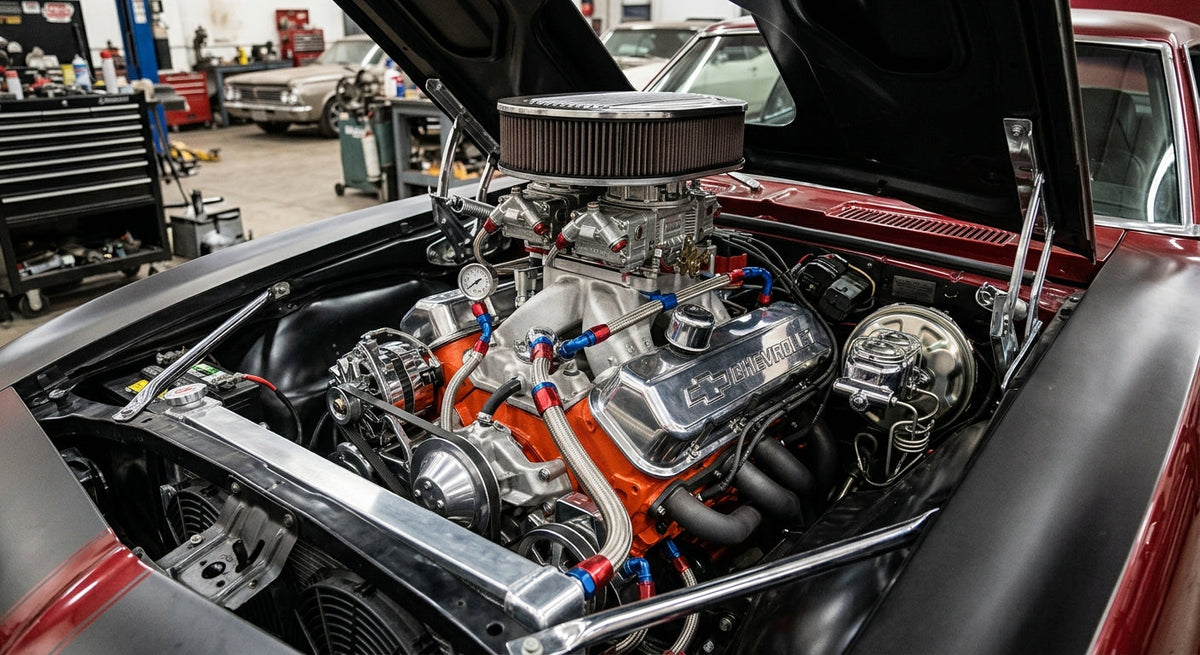
The right big block Chevy valve covers set the tone for the whole engine bay, because on a 396, 427, or 454 they are the largest visible surfaces under the hood. Fitment is less forgiving than style, though. Big block covers come in different bolt patterns and heights, and they sit close to the brake booster, the hood, and the headers. This guide covers how to identify your cover pattern, when you need tall covers, which materials hold up, and how air cleaners, breathers, and pulleys tie the look together.
Identify Your Valve Cover Bolt Pattern First
The classic Mark IV big block, which covers most 396, 402, 427, and 454 engines in muscle cars and trucks through the 1980s, uses perimeter-bolt valve covers. The bolts sit around the outer edge of the cover flange.
Later factory heads moved to center-bolt valve covers, where the bolts run down the middle of the cover. Aftermarket cylinder heads may use either pattern depending on design.
The quick check: pull a cover and look at where the bolt holes are on the head. Holes around the gasket rail mean perimeter-bolt. Holes down the center of the head mean center-bolt. Adapters exist to run perimeter-style covers on center-bolt heads, but they add height, so factor that into hood and booster clearance.
Standard vs. Tall Big Block Chevy Valve Covers
Standard-height covers clear stock stamped rockers and most mild cam combinations. Roller rocker arms, stud girdles, larger valve springs with taller retainers, and high-lift cams can all hit the inside of a standard cover.
Tall covers add internal clearance. To confirm you need them, rotate the engine so each rocker reaches full lift and measure from the cover gasket surface to the highest point of the valvetrain. Compare that number to the cover's published internal height, and leave a margin.
The brake booster problem
On many big block swaps, the driver's side valve cover sits close to the power brake booster. Tall covers can contact the booster or make it impossible to remove a cover without unbolting the master cylinder. Measure that gap before ordering. A smaller-diameter booster solves the conflict on many builds; see brake boosters for options.
Valve Cover Materials and Styles
| Style | Look | Watch For |
|---|---|---|
| Chrome stamped steel | Factory-era muscle car | Thin flanges flex and leak; use spreader bars |
| Cast aluminum, finned | Vintage hot rod and drag race | Check internal baffling for PCV |
| Fabricated or billet aluminum | Modern show engine | Highest cost; confirm height and breather holes |
| Painted factory-style | Restoration-correct | Match the color to the engine's original finish |
Chrome steel covers are the most affordable and the most leak-prone. The thin flange bends when bolts are tightened, which pinches the gasket at the bolt and lifts it between bolts. Spreader bars or reinforced flanges spread the clamping force. Cast aluminum covers have thick, rigid flanges and seal well with a quality gasket. Vintage-style finned aluminum covers are one of the most searched big block looks, and they suit traditional hot rods and gassers as well as muscle cars.
Whatever you choose, check that the covers have holes where you need them for a breather and PCV valve, and that they include internal baffles so oil is not pulled into the intake through the PCV system.
Gaskets and Torque
Molded rubber gaskets with a steel core resist over-crushing and can be reused. Cork gaskets are inexpensive and period-correct but compress unevenly and rarely survive a second install. Torque cover bolts lightly and evenly, following the cover manufacturer's spec. More torque does not stop leaks; it causes them, especially on stamped steel covers.
Air Cleaners, Breathers, and Oil Caps
A big block with a 4-barrel carburetor typically runs a 14-inch round air cleaner, and hood clearance is the limit. Drop-base air cleaners lower the lid to clear a stock hood. Taller filter elements flow more but need a hood scoop or cowl. Browse air cleaners by diameter and element height.
Match breathers and oil caps to the valve cover finish so the top of the engine reads as one set. If you are converting to EFI, confirm the throttle body's air cleaner flange size, since it may differ from your carburetor.
Pulleys and Brackets: Short vs. Long Water Pump
Big block Chevys used both short and long water pump designs, depending on the vehicle and year. The two are not interchangeable without changing pulleys and brackets, because the pulley planes sit at different distances from the block.
Identify your water pump before ordering pulleys or engine brackets. Buying the crank, water pump, and alternator pulleys as a matched set keeps belt alignment correct and the finish consistent. Adding air conditioning? Make sure the A/C compressor bracket matches the same water pump length.
Finishing the Bay
The details that separate a finished engine bay from a busy one: matching engine bolt kits in the same finish as the covers, a coordinated dress-up kit, and tidy wire and hose routing. Headers and exhaust affect the look too; big blocks commonly run 2.5- to 3-inch exhaust, covered in the Custom Exhaust Kit Builder's Guide.
Building a small block or LS instead? The Small Block Chevy Engine Dress-Up Guide and LS Engine Dress-Up Guide cover those engines with the same approach. For bolt-on upgrades beyond the engine, see The Muscle Car Bolt-On Blueprint.
FAQ
Are all big block Chevy valve covers the same?
No. Mark IV big block heads use perimeter-bolt valve covers, while later factory heads use center-bolt covers. Aftermarket heads can use either. Covers also come in standard and tall heights, so check your bolt pattern and valvetrain clearance before ordering.
Do I need tall valve covers on a big block Chevy?
You need tall covers if you run roller rockers, stud girdles, or valve springs with taller retainers that contact a standard cover. Measure valvetrain height at full lift and compare it to the cover's internal clearance.
Will tall valve covers hit my brake booster?
On many big block swaps, the driver's side cover sits close to the power brake booster. Measure the gap before buying tall covers. A smaller-diameter booster often solves the conflict.
Why do my chrome big block valve covers leak?
Stamped steel covers have thin flanges that bend when bolts are tightened, which unevenly crushes the gasket. Use spreader bars or reinforced-flange covers, a molded rubber gasket, and light, even torque.
Do small block and big block Chevy valve covers interchange?
No. Small block and big block Chevy heads use different valve cover shapes and bolt locations. Buy covers listed specifically for big block Chevy.
Does Hot Rod Hardware carry big block Chevy valve covers?
Yes. Hot Rod Hardware stocks valve covers, breathers, oil caps, air cleaners, pulleys, and engine brackets for big block Chevy builds. Call 507-527-1020 for fitment help or browse the engine accessories catalog online.
|
Shop Valve Covers at Hot Rod Hardware hotrodhardware.com/collections/valve-covers |