
| KEY TAKEAWAYS |
|---|
| • LS valve covers split into two camps: factory-style covers with visible coil packs, and hidden-coil covers that route the coils underneath for a cleaner look. |
| • Coil-near-plug LS engines need coil bracket geometry matched to their generation. A Gen III bolt pattern is not the same as a Gen IV bolt pattern. |
| • Tall-body covers are required for any LS running non-stock rocker arms or aftermarket valve springs with taller retainers. |
| • Billet aluminum covers cost more than cast but hold up better to repeated removal and give a more finished appearance in a show-quality bay. |
| • Hot Rod Hardware stocks LS valve covers, coil covers, and dress-up components for Gen III and Gen IV LS applications. |
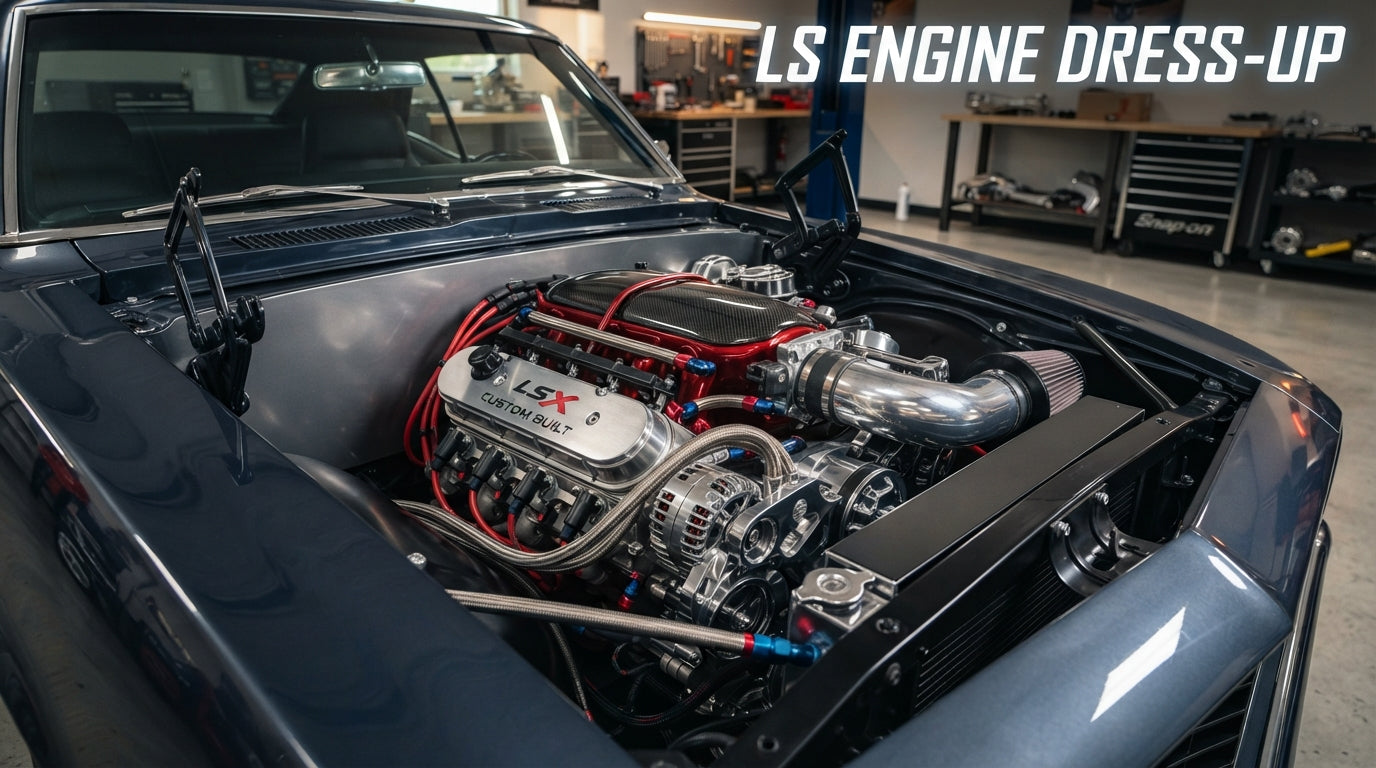
An LS swap changes the look of an engine bay as much as it changes the way a car drives. Factory LS valve covers do the job but look plain, and most builders replace them within the first year of ownership. Choosing the right LS valve covers means understanding coil configuration, rocker clearance, and hood height before you order, not after. This guide covers the two main valve cover styles, how coil mounting affects your options, pulley system choices, and the brands Hot Rod Hardware stocks for Gen III and Gen IV LS engines.
LS Valve Covers: Coil-Near-Plug vs. Hidden Coil
Every LS engine uses coil-near-plug ignition. Instead of a distributor, each cylinder gets its own coil mounted close to the spark plug. In the factory layout, those coils bolt directly to the valve cover and sit exposed on top of the engine. That is the look most people picture when they think of an LS engine bay, and it is the simplest option to build around.
Hidden-coil valve covers take a different approach. The coils relocate under the cover, either to internal brackets machined into a billet cover or to a separate bracket that mounts elsewhere on the engine, and the cover itself presents a clean, uninterrupted surface. This is the look behind most show-quality LS bays. It costs more and takes longer to wire, since the coil harness has to route differently than stock, but it removes the cluttered look of eight coil packs standing in a row.
Decide which route you want before you shop. Hidden-coil covers are not a drop-in replacement for coil-near-plug covers. They require a different coil relocation bracket and, in most cases, extended coil harness leads.
Coil Mount Compatibility by LS Generation
LS engines are not all interchangeable when it comes to valve cover and coil bracket bolt patterns. Confirm your specific engine before ordering covers.
| Engine Family | Examples | Coil Mount Notes |
|---|---|---|
| Gen III | LS1, LS6, 4.8/5.3/6.0 truck (LM7, LQ4, LQ9) | Coil brackets bolt to valve cover in stock form; most aftermarket covers match this pattern. |
| Gen IV | LS2, LS3, LS7, L92, L99 | Different valve cover bolt spacing than Gen III; confirm cover is listed for Gen IV before ordering. |
| Gen IV truck (Vortec) | 5.3/6.0/6.2 (L83, L96, L9H) | Shares Gen IV cover bolt pattern but coil bracket spacing can vary by model year. |
Cast, Billet, or Fabricated Covers
Cast aluminum covers are the budget option and the safest starting point for a street build. They are OEM-style, widely available, and inexpensive to replace if you change direction on the build later.
Billet aluminum covers are machined from solid stock and finished in polished, black anodized, or powder-coated options. They cost more, but the surface finish holds up to repeated removal for valve adjustments without the pitting that shows up on lower-grade cast covers over time.
Fabricated covers, usually TIG-welded aluminum with a flat or machined top, are the choice for a fully custom bay where every component is coordinated to match. They are the most expensive option and the least forgiving of heat cycling, so use a quality gasket and follow the manufacturer's torque spec.
| Style | Cost | Best For |
|---|---|---|
| Cast aluminum | Lowest | Street builds, budget-conscious swaps |
| Billet aluminum | Mid to high | Show-quality bays, repeated valve access |
| Fabricated / custom | Highest | Fully coordinated, one-off engine bays |
Tall vs. Standard Height and Rocker Clearance
Standard-height covers clear the factory LS rocker assembly with no issue. That changes the moment you install aftermarket rockers, higher-lift camshafts, or valve springs with taller retainers. Any of those upgrades can bring the rocker assembly into contact with a standard cover.
Tall-body covers, sometimes listed as hidden coil valve covers when they combine both features, add roughly half an inch to an inch of internal clearance depending on the manufacturer. Confirm the clearance spec against your specific rocker and spring combination before ordering. When in doubt, measure from the top of the rocker arm at full lift to where the stock cover gasket surface sits, then compare that figure to the tall cover's published internal depth.
For the coil covers and breather caps that finish the look once the valve covers are sorted, see the coil covers collection.
Pulleys and Accessory Drive
LS engines run a serpentine belt system from the factory, which means a single belt drives every accessory and pulley alignment matters more than it did on a V-belt small block. Mismatched pulley finishes are one of the more common visual mistakes in an otherwise clean LS bay.
Chrome and polished billet pulleys are available as matched sets designed for the LS accessory drive, and buying the crank, water pump, and alternator pulleys as a set avoids the mismatch problem entirely. Confirm the set is designed for your specific accessory bracket configuration. Truck-based LS engines and Corvette-based LS engines often use different accessory drive layouts even when the block itself is the same.
Where LS Dress-Up Fits in a Larger Build
Engine dress-up is usually one phase of a bigger LS swap. If you are still evaluating whether an LS swap is right for your platform, The LS Swap Revolution covers the cost, weight, and aftermarket tradeoffs of the LS platform in depth. Fuel delivery is the other piece most builders tackle around the same time as dress-up; the Classic Car Fuel System Build Guide covers tank, pump, and AN fitting selection from first principles.
If you are dressing up a small block Chevy instead of an LS, the material choices and fitment logic are nearly identical; see the Small Block Chevy Engine Dress-Up Guide for the SBC-specific version of this process.
FAQ
What valve covers fit an LS1 with stock coil-near-plug ignition?
Any cover listed for Gen III LS engines will match the LS1's coil bracket bolt pattern. Confirm the listing specifies Gen III or LS1/LS6 compatibility, since Gen IV covers use different bolt spacing.
Do hidden-coil LS valve covers work with any LS generation?
No. Hidden-coil covers are built around a specific coil relocation bracket, and that bracket is generation-specific. Confirm the cover and coil bracket are sold as a matched set for your engine before ordering.
Do I need tall valve covers with stock LS rocker arms?
No. Stock rocker arms clear standard-height covers with no modification. Tall covers are only necessary with aftermarket rockers, high-lift cams, or taller valve spring retainers.
What's the difference between LS1 and LS3 valve cover bolt patterns?
The LS1 is a Gen III engine and the LS3 is a Gen IV engine. The two generations use different valve cover bolt spacing and different coil bracket mounting points, so covers are not interchangeable between them without confirming generation compatibility.
Does Hot Rod Hardware ship LS valve covers?
Yes. Hot Rod Hardware ships LS valve covers, coil covers, and accessory pulleys for Gen III and Gen IV LS applications across the continental US. Contact HRH at 507-527-1020 or browse the engine accessories catalog online.