
| KEY TAKEAWAYS |
|---|
| • The 1968-1972 GM A-body platform includes the Chevelle, Malibu, El Camino, GTO, LeMans, Tempest, Cutlass, 442, Skylark, and GS. They share front and rear suspension design. |
| • Factory A-body suspension uses coil springs with short and long control arms up front and a four-link rear. Soft springs, rubber bushings, and weak rear arm mounts limit handling. |
| • A coilover conversion replaces springs and shocks with adjustable coilovers, usually alongside new front lower arms and rear trailing arms. |
| • Spring rates depend on engine weight. A big block car needs firmer front springs than a small block or LS car. |
| • Do suspension first, then brakes and steering. Upgrades work best as a system. |
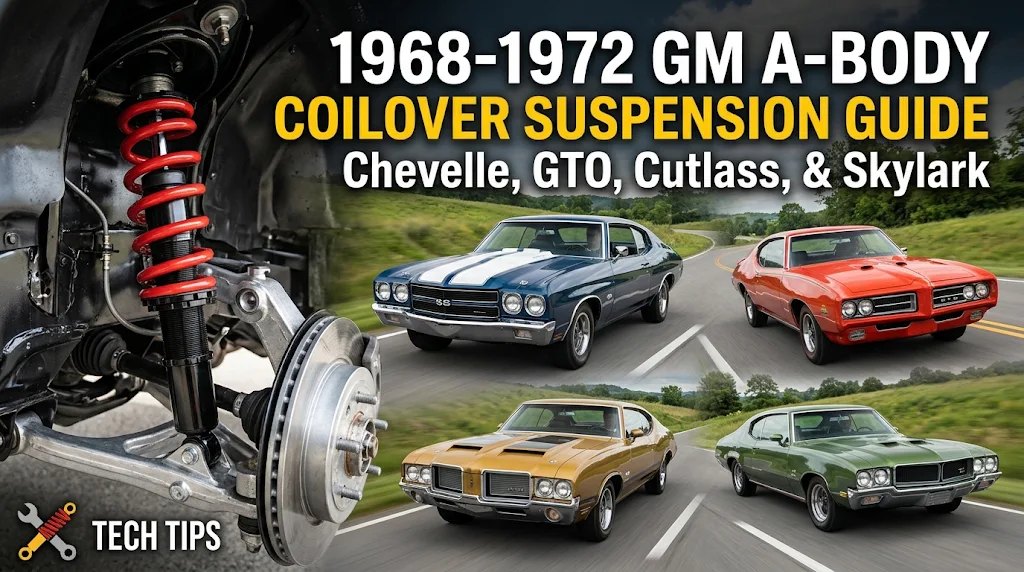
A Chevelle suspension upgrade on a 1968-1972 GM A-body usually means replacing the factory coil springs and shocks with adjustable coilovers, along with new control arms and sway bars. The A-body platform covers the Chevelle, Malibu, El Camino, Pontiac GTO, LeMans, Tempest, Oldsmobile Cutlass, 442, and Buick Skylark and GS. All of them share the same basic suspension design, so most coilover systems fit across the platform.
This guide explains how the factory suspension works, the upgrade paths available, what a coilover conversion includes, and the order to do the work in. If your A-body is your first muscle car, our muscle car bolt-on blueprint gives a wider view of where to start.
How Factory A-Body Suspension Works
Up front, 1968-1972 A-bodies use short and long arm (SLA) independent suspension. The coil spring sits in a pocket in the lower control arm, and the shock runs through the center of the spring. In the rear, a four-link design uses two lower trailing arms and two angled upper arms to locate the axle, with coil springs on the lower arms.
The design is sound, but the factory parts were tuned for comfort in 1968. Soft springs allow body roll and nose dive. Rubber bushings deflect under load. Stock geometry gives little caster, which makes steering feel light at speed. The rear upper arm mounts on the axle housing and frame can also crack on cars with more power.
Upgrade Paths for A-Body Suspension
| Upgrade Path | What Changes | Ride and Handling | Adjustability | Best For |
|---|---|---|---|---|
| Springs, shocks, and sway bars | Performance springs, quality shocks, larger sway bars, new bushings | Big improvement over stock | Limited | Street cars on a budget |
| Coilover conversion | Coilovers front and rear with new lower arms and trailing arms | Firm control, tunable ride | Ride height and damping | Restomods and pro-touring builds |
| Air ride | Air springs with matched shocks | Comfortable, variable stance | Ride height on demand | Show cars and low stance builds |
| Full chassis replacement | New frame with modern suspension | Most capable | Extensive | Ground-up builds |
Many owners start with springs, shocks, and sway bars, then move to coilovers once the engine and brakes are sorted. If you want variable ride height, explore air ride kits and components.
What an A-Body Coilover Conversion Includes
Front suspension
Front coilovers replace both the spring and the shock. Because the factory lower arm holds the spring in a pocket, a coilover conversion uses a new tubular lower control arm with a coilover mount. Most systems also add tubular upper arms that build in more caster for better high-speed stability. Some systems offer taller spindles to improve camber gain, which matters more on cars driven hard in corners. Browse control arms for individual pieces.
Rear suspension
In the rear, coilovers mount to new lower trailing arms or brackets in place of the factory springs. Replacing the upper arms with adjustable units lets you set pinion angle, and stronger arms reduce stress on the factory mounts. Check the upper arm mounts on the axle housing and frame for cracks before installing anything. A rear sway bar helps balance the car once the front is firmed up.
A complete system
A complete kit takes the guesswork out of matching parts. Hot Rod Hardware carries a Ridetech coilover system for 1968-72 A-body cars designed for the platform. Individual shocks, sway bars, and rear suspension kits are also available if you are building your own combination.
Choosing Spring Rates
Coilover springs are sold by rate, measured in pounds per inch. Front spring rate depends mostly on engine weight. A big block A-body needs firmer front springs than the same car with a small block or an aluminum LS. Rear rates depend on rear weight and how firm you want the ride. Tell the kit maker your engine, transmission, and intended use, and start with their recommended rates. Adjustable shocks let you fine-tune from there.
Build Order for an A-Body Suspension Upgrade
- Inspect the frame, body mounts, and rear upper arm mounts. Repair cracks before installing new parts.
- Install front control arms, coilovers, and sway bar.
- Install rear trailing arms, upper arms, coilovers, and sway bar.
- Set ride height, then get a four-wheel alignment with the caster and camber the kit maker recommends.
- Upgrade brakes to match the added grip. See how to choose a disc brake conversion kit.
- Consider a quicker steering box or power steering upgrade once the chassis is sorted.
Our restomod suspension and brake upgrade sequence explains why this order saves money, and hot rod suspension geometry covers how ride height changes alignment.
Engine Swaps and Firewall Clearance
Many A-body restomods pair a coilover suspension with an LS swap. If the engine is moving rearward or you want a clean engine bay, a 1968-72 GM car smooth firewall with 2" setback is an option. Read more in the LS swap revolution, and see why the A-body ranks among the best muscle cars to turn into hot rods.
1968-1972 vs. 1964-1967 A-Body
The 1964-1967 A-body shares a similar suspension layout, but frame and body dimensions changed for 1968. Some components, like upper control arms, are made to fit 1964-1972, while coilovers and complete systems are usually specific to one range. Confirm the year range on every part before ordering.
Frequently Asked Questions
Which cars are GM A-body?
The 1968-1972 GM A-body includes the Chevrolet Chevelle, Malibu, and El Camino, the Pontiac GTO, LeMans, and Tempest, the Oldsmobile Cutlass and 442, and the Buick Skylark, Special, and GS.
Do coilovers bolt into a Chevelle?
Most A-body coilover systems bolt in using factory mounting points, with new front lower arms and rear trailing arms carrying the coilovers. The Ridetech system Hot Rod Hardware carries is a bolt-on kit. Read the instructions before you start.
Are coilovers better than air ride on a Chevelle?
Coilovers give firmer, more consistent handling and suit performance driving. Air ride lets you change ride height on demand and suits show cars and low stances. Both are big upgrades over stock.
What spring rate do I need for a big block Chevelle?
A big block needs a firmer front spring than a small block or LS. Give the kit maker your engine and intended use and start with their recommended rate.
Do I need new spindles for a coilover conversion?
Not necessarily. Many systems work with factory-style spindles. Taller spindles improve camber gain for cars driven hard in corners.
Will coilovers make my Chevelle ride rough?
Not if the spring rates are right for the car's weight. Adjustable shocks let you soften the ride for street driving and firm it up for spirited driving.
|
Shop the Parts Shop the Ridetech 1968-72 A-body coilover system, control arms, sway bars, and shocks at Hot Rod Hardware. Questions about fitment? Call 507-527-1020. |