
| KEY TAKEAWAYS |
|---|
| • The AN dash number is the tube outside diameter in sixteenths of an inch. A -6 AN fitting matches 6/16" (3/8") tube, and a -8 matches 8/16" (1/2") tube. |
| • Every AN fitting seals on a 37-degree flare with a straight UNF thread. It will not seal against a 45-degree SAE inverted flare or a tapered NPT port without an adapter. |
| • Hose inside diameter is smaller than the dash size suggests. Size fuel lines by flow, not by matching the number on the pump port. |
| • -6 AN covers most street fuel systems, carbureted or EFI. Step to -8 feed when horsepower or pump volume climbs. |
| • PTFE-lined hose is the safer choice for EFI and ethanol blends, but it needs PTFE-specific hose ends. |
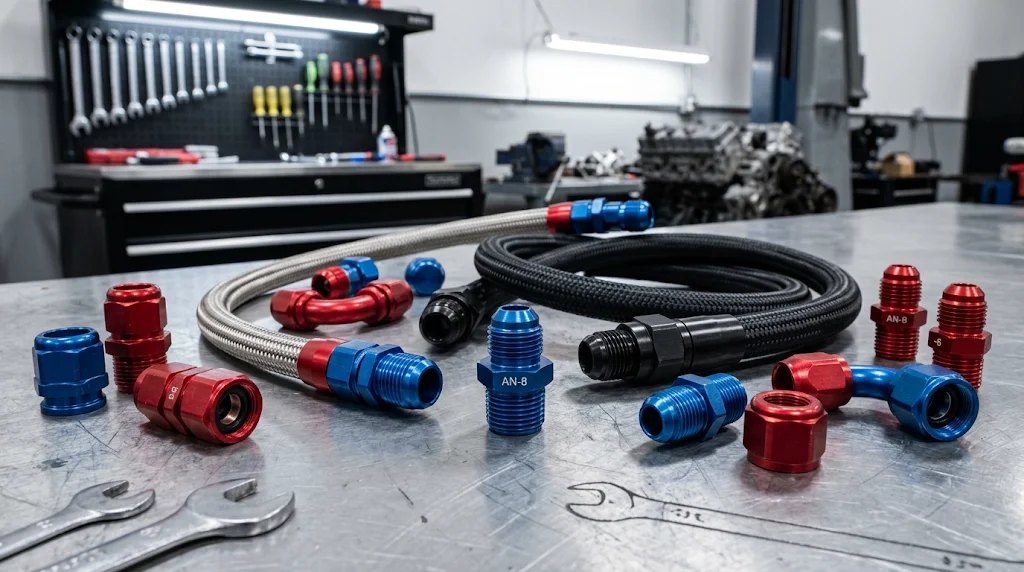
An AN fitting size chart converts dash sizes like -4, -6, and -8 into real measurements you can match to tube, hose, and ports. The AN number equals the tube outside diameter in sixteenths of an inch, so a -6 AN fitting fits 3/8" tube and a -8 fits 1/2" tube. All AN fittings use a 37-degree flare and a straight UNF thread, which is why a -6 hose end from one brand threads onto a -6 adapter from another.
AN stands for Army-Navy, the military standard that defined these fittings for aircraft plumbing. Hot rodders adopted them because they reseal reliably, handle vibration, and come apart without damaging the line. This guide gives you the full size chart, metric conversions, the AN size to run for each system in a classic car, and the fitting types you should never mix.
How AN Dash Sizes Work
The dash number is a fraction with 16 on the bottom. Take the number, put it over 16, and you have the tube outside diameter in inches. A -4 is 4/16", or 1/4". A -10 is 10/16", or 5/8". To convert to millimeters, multiply the dash number by 1.5875.
That number describes the tube, not the hose. Braided hose has a wall, so its inside diameter is always smaller than the dash size. A -6 hose has roughly a 0.34" inside diameter, not a full 3/8". This matters most on fuel systems, where inside diameter sets how much fuel the line can move.
AN Fitting Size Chart
| AN Size | Tube OD (in) | Tube OD (mm) | Thread (UNF) | Typical Hose ID | Common Uses |
|---|---|---|---|---|---|
| -3 | 3/16" | 4.8 mm | 3/8-24 | 0.15" | Brake flex lines, gauge feeds |
| -4 | 1/4" | 6.4 mm | 7/16-20 | 0.22" | Oil pressure gauge, brake lines, turbo oil feed |
| -6 | 3/8" | 9.5 mm | 9/16-18 | 0.34" | Fuel feed and return, trans cooler, power steering |
| -8 | 1/2" | 12.7 mm | 3/4-16 | 0.44" | High-volume fuel feed, oil cooler lines |
| -10 | 5/8" | 15.9 mm | 7/8-14 | 0.56" | Oil cooler, remote oil filter, dry sump |
| -12 | 3/4" | 19.1 mm | 1-1/16-12 | 0.69" | Dry sump, large oil and coolant lines |
| -16 | 1" | 25.4 mm | 1-5/16-12 | 0.89" | Coolant, crankcase breathers |
| -20 | 1-1/4" | 31.8 mm | 1-5/8-12 | 1.12" | Radiator and large coolant lines |
Hose ID figures are typical for rubber-core braided hose. PTFE-lined hose runs slightly smaller. Check the hose maker's spec sheet for exact numbers.
AN Fitting Sizes in Inches and Millimeters
AN is an inch-based system, but many modern EFI components use metric ports. The chart above lists the metric equivalent of each tube size. Keep in mind that a metric port is not an AN port. A fuel rail with an M12x1.5 or M14x1.5 thread needs a metric-to-AN adapter, not a -6 fitting forced into place.
The same caution applies to O-ring boss (ORB) ports. A -6 ORB port shares the 9/16-18 thread with a -6 AN fitting, but it seals with an O-ring on a flat face instead of a flare. Order ORB adapters for ORB ports and AN flare fittings for flare connections.
Which AN Size Do You Need?
Start with the component maker's recommendation when one exists. Pump, regulator, and cooler instructions usually list a minimum line size. When they don't, these ranges cover most street builds.
| System | Typical AN Size | Notes |
|---|---|---|
| Carbureted fuel feed | -6 | Covers most street engines. Step to -8 on high-horsepower or high-volume pumps. |
| EFI fuel feed | -6 to -8 | -6 feed suits most street EFI setups. Use -8 feed when power or pump volume calls for it. |
| EFI fuel return | -6 | A return that is too small raises base pressure at idle. |
| Brake flex lines | -3 | Use DOT-compliant brake hose assemblies only. |
| Oil pressure gauge feed | -3 or -4 | Small line, low flow. Restrictor fittings are common. |
| Oil cooler or remote filter | -8 to -10 | Larger lines reduce pressure drop through the cooler. |
| Transmission cooler | -6 to -8 | Most automatics run -6. Match the cooler ports. |
| Power steering | -6 | Pressure side needs high-pressure hose rated for steering systems. |
| Coolant and radiator | -16 to -20 | Common on custom radiators with AN bungs. |
If you are planning a complete fuel system, our EFI fuel system components guide covers pump sizing and return versus returnless layouts, and the classic car fuel system build guide walks through tank, pump, and line routing from the start.
AN vs. Inverted Flare vs. NPT vs. ORB
Four fitting styles show up on classic cars, and they look similar enough to cause leaks when mixed. Each one seals a different way.
| Fitting Type | How It Seals | Where You Find It |
|---|---|---|
| AN (JIC) | 37-degree flare, straight thread | Aftermarket braided hose, fuel cells, EFI plumbing |
| SAE inverted flare | 45-degree flare, straight thread | Factory steel brake and fuel lines |
| NPT (pipe thread) | Tapered thread with sealant | Fuel tanks, senders, carburetor inlets, gauge ports |
| ORB (O-ring boss) | O-ring on a flat port face | Modern pumps, regulators, filters, some fuel rails |
A 37-degree AN flare and a 45-degree inverted flare will thread together in some sizes, and they will leak. Use an adapter to bridge the two. Hot Rod Hardware stocks an inverted flare to -6AN adapter for joining factory-style hard line to braided hose, along with NPT to inverted flare brass fittings for tank and sender connections.
Rubber Braided Hose, PTFE Hose, or Hard Line
Rubber-core braided hose is flexible, easy to assemble, and the least expensive option. Over time, fuel can permeate the rubber core and leave a gas smell in an enclosed garage. PTFE-lined hose resists permeation and handles ethanol blends, which makes it the better pick for EFI and E85. It is stiffer, has a larger bend radius, and requires PTFE-specific hose ends.
For long runs along the frame, hard line is often cleaner and cheaper than braided hose. Run aluminum or stainless tube for the length of the chassis, then switch to short braided sections where the line has to flex between the frame and the engine or tank. Secure every run with clamps such as Russell -6AN cushion clamps every 12 to 18 inches.
How to Identify an Unknown Fitting
- Measure the thread outside diameter with calipers.
- Count threads per inch with a thread pitch gauge.
- Check the seat angle with a flare gauge: 37 degrees means AN, 45 degrees means SAE inverted or standard flare.
- If the thread tapers and has no flare seat, it is pipe thread. Look for an O-ring groove to spot ORB.
- Match the thread size and pitch against the chart above.
Assembly Tips That Prevent Leaks
- Use aluminum AN wrenches. Open-end steel wrenches round off anodized fittings.
- Put a drop of oil or assembly lube on the threads and flare before tightening.
- Tighten to snug and then a small additional turn. Overtightening cracks the flare.
- Wrap braided hose with tape before cutting, and cut with a fine-tooth blade or cutoff wheel to keep the braid from fraying.
- Blow out every hose after cutting to clear debris before it reaches injectors or a carburetor.
- Pressure-check the system with the engine off before the first start. Add a -6AN check valve where the system design calls for one.
Frequently Asked Questions
What size is a -6 AN fitting?
A -6 AN fitting matches 3/8" (9.5 mm) tube outside diameter and uses a 9/16-18 UNF thread. Typical -6 braided hose has about a 0.34" inside diameter.
What is -8 AN in inches?
-8 AN equals 1/2" tube outside diameter with a 3/4-16 UNF thread. The hose inside diameter is roughly 0.44".
How do I convert AN fitting sizes to millimeters?
Multiply the dash number by 1.5875. A -6 is about 9.5 mm, a -8 is 12.7 mm, and a -10 is about 15.9 mm. Those numbers describe tube outside diameter, not metric thread size.
Is -6 AN the same as 3/8"?
It matches 3/8" tube outside diameter. It is not the same as 3/8" NPT, which is a pipe thread size with a much larger actual thread diameter.
Can I connect AN fittings to factory steel lines?
Not directly. Factory lines use a 45-degree inverted flare, and AN uses a 37-degree flare. Use an inverted flare to AN adapter between them.
What AN size should I use for EFI fuel lines?
Most street EFI systems run a -6 feed and -6 return. Higher-horsepower builds or larger pumps often step up to a -8 feed. Follow the pump maker's minimum line size.
|
Shop the Parts Ready to plumb your build? Shop hoses and fittings, fuel pumps, and Tanks Inc. fuel system parts at Hot Rod Hardware, or call our team at 507-527-1020 to match fittings to your components. |