
|
Key Takeaway A 4-link suspension uses four control bars to locate the rear axle and manage the forces from acceleration, braking, and cornering. It gives builders more geometry control than a leaf spring or ladder bar setup. Getting the geometry right requires understanding bar length, pinion angle, and triangulation. |
What Is a 4-Link Suspension?
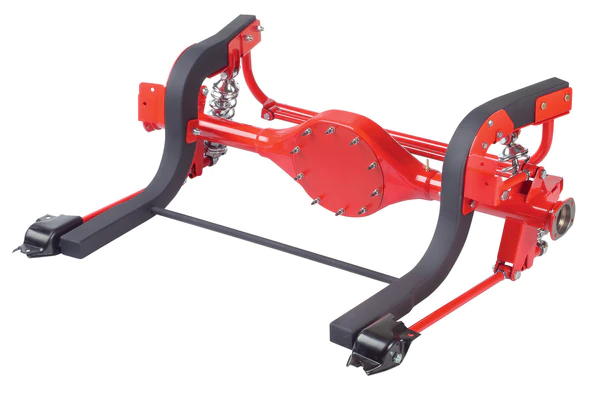
A 4-link suspension is a rear suspension design that uses four control arms to locate the axle housing relative to the chassis. Two upper bars and two lower bars, one pair on each side of the axle, prevent the axle from moving forward, backward, or sideways under load. Coilover shocks handle vertical movement independently from the bars.
The "four link" name refers to the four bars. Each bar is a rigid link connected at one end to a bracket on the axle housing and at the other end to a bracket on the frame. When the rear wheels hit a bump or the engine puts power to the ground, the bars control where the axle goes and how far.
4-link suspensions replaced leaf springs and ladder bars on performance hot rods because they offer more geometry adjustability and better weight transfer control under hard acceleration. The geometry is entirely determined by bar length, mounting height, and the angle of each bar relative to the frame.
How a 4-Link Suspension Works
Under acceleration, the engine's torque pushes the axle housing clockwise (from the driver's side view). This is called axle wrap. On a leaf spring setup, the spring itself resists this rotation, which causes the leaf to distort in an S-curve under hard acceleration. A 4-link setup resists axle wrap through the bars instead of the spring. The upper bars control the axle's rotational tendency while the lower bars resist forward and rearward movement.
The geometry of the bars determines how load transfers to the rear wheels during acceleration. Bars angled upward from the axle toward the front of the car create an instant center, the theoretical point where the lines from both bars intersect. The location of the instant center determines how aggressively the rear of the car squats on hard acceleration.
Moving the instant center higher and further forward increases anti-squat, which transfers more weight to the rear tires during acceleration. For a drag-oriented hot rod, high anti-squat helps plant the tires. For a road car that needs to corner at speed, a lower anti-squat setting gives better balance.
4-Link vs. Ladder Bar vs. Leaf Spring
|
Factor |
4-Link |
Ladder Bar |
Leaf Spring |
|
Geometry adjustability |
High |
Moderate |
Low |
|
Cost |
Higher |
Moderate |
Lower |
|
Fabrication complexity |
High |
Moderate |
Low |
|
Anti-squat control |
Precise |
Limited |
Fixed by spring rate |
|
Street ride quality |
Excellent (with coilovers) |
Good |
Good to excellent |
|
Drag racing use |
Common |
Very common |
Common (traditional) |
|
Appearance |
Modern, clean |
Traditional strip look |
Traditional/classic |
4-Link Suspension Geometry: Getting It Right
4-link geometry is defined by four measurements: upper bar length, lower bar length, upper bar mounting height at the axle and frame, and lower bar mounting height at the axle and frame. Changing any one of these moves the instant center and changes the suspension behavior.
Bar length
Longer bars create a more rearward instant center, which reduces the aggressiveness of weight transfer under acceleration. Shorter bars move the instant center forward and raise anti-squat. Most street-driven hot rod 4-link kits use lower bars between 24 and 30 inches and upper bars between 18 and 24 inches.
Bar angles
The upper bars typically angle downward from the axle to the frame on a street car. The lower bars angle upward slightly. This configuration places the instant center above the axle and ahead of the rear wheels, which gives controlled squat without the violent weight transfer of an extreme drag setup.
Pinion angle
Pinion angle is the angle of the driveshaft yoke on the rear axle housing relative to the driveshaft. Proper pinion angle ensures the u-joints operate at matched angles and cancel out vibration. On a 4-link setup, pinion angle changes as bar mounting heights change. Most street builds run one to three degrees of downward pinion angle to cancel driveshaft vibration at cruise speed.
Triangulated vs. Non-Triangulated 4-Link
A non-triangulated 4-link runs all four bars parallel to the centerline of the car. This design requires a separate Panhard bar or Watts link to prevent the axle from moving side to side. Non-triangulated setups allow independent adjustment of each bar and are the most common design in purpose-built hot rod chassis.
A triangulated 4-link angles the upper bars inward toward the frame, forming a triangle shape when viewed from above. This triangulation prevents lateral axle movement without a separate Panhard bar, which simplifies the installation. The trade-off is less independent adjustability in the upper bar angles. RideTech and Heidt's both offer triangulated 4-link kits for popular hot rod applications where Panhard bar clearance is a concern.
Which Hot Rod Builds Benefit Most from 4-Link Suspension
Any build where the builder wants to tune the rear suspension behavior benefits from a 4-link. Street rods that see performance driving, drag-oriented builds that need adjustable weight transfer, and pro-touring cars that need to handle different tracks and surface conditions all benefit from the adjustability a 4-link provides.
For traditional or rat rod builds that prioritize appearance and simplicity over tuning, a leaf spring or ladder bar setup is a lower-cost and lower-complexity alternative that still performs well. The 4-link makes the most sense when the builder plans to actually use the adjustability it provides.
RideTech offers 4-link systems for Chevrolet and GM applications with coilover shocks, adjustable bars, and detailed setup instructions. Heidt's provides kits for early Ford and GM hot rod applications. Both manufacturers publish setup guides that walk through pinion angle and instant center calculations for common build configurations.
Frequently Asked Questions
What is a 4-link suspension?
A 4-link suspension uses four rigid control bars to locate the rear axle and manage the forces from engine torque and road inputs. Two bars on each side of the axle connect the axle housing to the frame. The bars replace the spring as the primary locating element, allowing the builder to adjust geometry by changing bar angles and lengths.
What is the difference between a 4-link and a ladder bar suspension?
A ladder bar uses a single triangular bar on each side of the axle instead of two separate bars. The ladder bar's triangular shape inherently prevents axle rotation without needing both upper and lower bars. A 4-link is more adjustable because each bar can be set independently. Ladder bars are simpler to install and work well on dedicated drag cars. 4-link setups are preferred when geometry tuning matters.
Does a 4-link need a Panhard bar?
A non-triangulated 4-link needs a Panhard bar or Watts link to prevent side-to-side axle movement. The four bars in a non-triangulated setup only control forward and rearward movement and axle rotation. Lateral location requires a separate component. A triangulated 4-link angles the upper bars to prevent lateral movement without a Panhard bar.
How do I set the pinion angle on a 4-link?
Set the car at ride height with the suspension at static position. Measure the driveshaft angle with a digital angle finder or inclinometer. Then measure the pinion yoke angle. For most street builds, set the pinion angle one to three degrees below the driveshaft centerline so the angles cancel out and the u-joints run in phase. Finalize the setting with the car at its actual ride height loaded with driver weight.
Related Products:
|
Shop 4-link suspension kits and coilovers at Hot Rod Hardware Browse RideTech, Heidt's, and rear suspension components at hotrodhardware.com |